
I counted every hit the way some people count sober days—quietly, one mark at a time. Numbers felt safer than memories.
My name is Emily Carter, and by the time I reached three hundred marks in the small spiral notebook hidden behind the flour canister in my kitchen, I was six months pregnant.
The first mark had happened years earlier in our tiny apartment outside Minneapolis. It was only a shove, the kind that left no bruise and gave my husband Lucas room to say it “didn’t count.” I believed him then. Or maybe I just wanted to.
Over time, the pushes became slaps. The slaps became punches. Eventually, he started using his belt. That’s when I began the notebook. A dot meant a slap. A line meant a punch. A hollow circle meant the belt.
When I found out I was pregnant, I convinced myself everything would change. I told myself Lucas would become softer once he knew he was going to be a father. Instead, he became more controlling.
He criticized how I talked, how I dressed, how long I spent on work calls. I worked remotely for a medical billing company, which meant I was home most of the time—exactly where Lucas liked me.
But during quiet moments, I started planning.
From my laptop, I copied documents, emailed myself financial records, and opened a separate bank account. I called a domestic violence hotline once from my car in a grocery store parking lot. The advocate on the phone told me something I repeated to myself for weeks:
“You are not crazy. You are in danger.”
The day the notebook reached three hundred, my baby kicked hard enough to make me gasp. I sat on the bathroom floor with my hand on my stomach and whispered, “I’m getting us out.”
But Lucas came home early that afternoon.
He had seen a simple Slack message from a male coworker—a smiley face emoji. That was enough. His anger exploded instantly.
“You think you can make me look stupid?” he shouted.
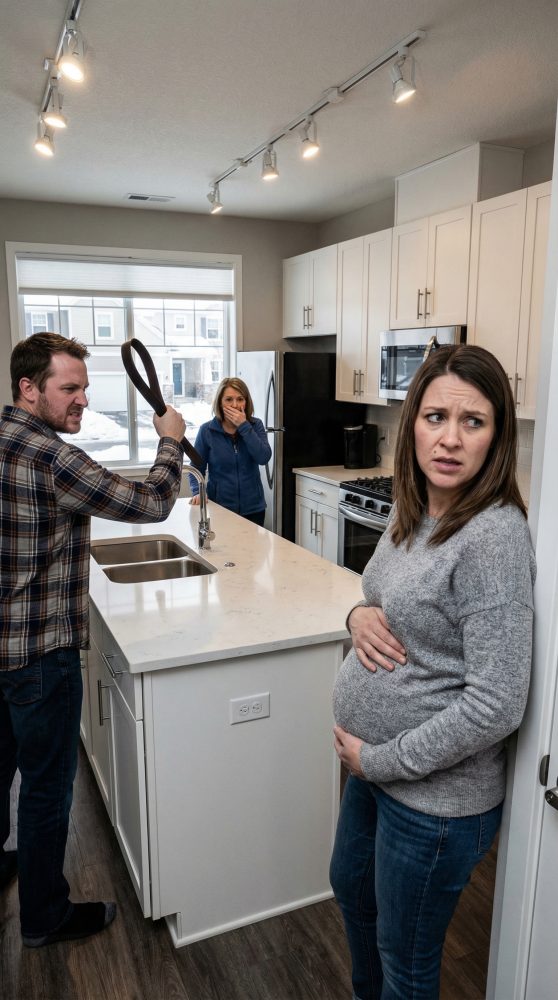
I backed down the hallway while he slid his belt from his waist.
What Lucas didn’t know was that my friend Tessa had arrived ten minutes earlier to drop off a bassinet she’d bought for the baby. She was in the kitchen.
Lucas raised the belt high above his shoulder.
And then Tessa stepped out from behind the counter.
“Stop!” she yelled.
Lucas froze for a fraction of a second.
But then his face twisted with rage—and he swung the belt down anyway.
That moment changed everything.
The belt cracked through the air, but it never reached me.
Tessa lunged forward and grabbed Lucas’s wrist with both hands. The sudden interruption stunned him. For years, his violence had happened behind closed doors, in silence. Now there was a witness.
“Get away from her!” Tessa shouted.
Lucas shoved her hard against the kitchen counter. A wineglass slipped from her hand and shattered across the tile floor.
Everything suddenly felt louder—the glass breaking, my heart pounding, Tessa breathing heavily as she pulled out her phone.
“I’m calling 911!” she said.
Lucas turned toward her with a look I had seen too many times before—the moment when he decided who would suffer next.
But this time, I was ready.
My phone was already in my hand, hidden behind my thigh. I pressed the emergency shortcut I had set weeks earlier after speaking with the hotline advocate. The alarm siren blasted through the room while a prewritten text message sent automatically to my brother and to my neighbor down the street.
If you get this, call the police.
Lucas lunged toward me, trying to grab the phone, but before he could reach me, the front door suddenly opened.
My neighbor, Mrs. Delgado, stood in the doorway wearing slippers and holding her phone like a shield. Her teenage son stood just behind her, already recording.
“I already called the police,” she said calmly. “Step away from her.”
For the first time since I’d known him, Lucas looked unsure. His shoulders dropped slightly as he tried to shift the situation.
“This is a misunderstanding,” he said quickly. “My wife is emotional. She’s pregnant—”
“It’s not a misunderstanding,” I interrupted.
The words came out thin but steady.
“He hits me.”
The room went silent.
Within minutes, the sound of police sirens filled the street. Two officers stepped inside. One approached Lucas while the other came straight toward me.
“Ma’am, are you pregnant?” she asked gently.
“Yes,” I said. “And he uses a belt.”
Her eyes moved briefly to the belt lying on the floor before returning to me. She nodded slightly and guided me to sit down.
Lucas kept talking, trying to explain, trying to twist the story.
But I reached into my purse and pulled out the spiral notebook.
Three hundred marks stared back from the pages.
“These are the times,” I told the officer. “All of them.”
When they placed the handcuffs on Lucas, his composure finally broke.
“You’re ruining my life!” he shouted at me.
For the first time in years, I met his eyes without fear.
“No,” I said quietly.
“You did that yourself.”
The next twenty-four hours felt like stepping into a completely different life.
At the hospital, doctors checked the baby’s heartbeat first. The steady rhythm filled the small exam room, and I realized I had been holding my breath for months without knowing it.
“He’s strong,” the nurse said with a smile.
I cried harder than I expected.
Later that night, a victim advocate sat with me and helped file an emergency protective order. Tessa stayed beside me with an ice pack on her elbow, refusing to leave even though I told her she could go home.
“I’m not going anywhere,” she said.
Lucas was released the next day under strict conditions: no contact, no access to the house, and a mandatory court appearance. He tried calling from unknown numbers again and again, but the advocate had already shown me how to document every attempt.
This time, the system was counting with me.
In court a week later, I had to walk past him in the hallway. Without the house, the control, and the privacy he used to hide his behavior, he looked smaller somehow.
His lawyer talked about stress and misunderstandings.
Then the judge looked at me.
“Would you like to speak?” she asked.
My hands trembled, but I stood.
I didn’t tell every detail of the years we spent together. There wasn’t time for that. Instead, I told the truth about the pattern. The waiting until we were alone. The belt. The notebook.
And the night someone finally saw it happen.
The judge reviewed the police report and the video Mrs. Delgado’s son had recorded. When the gavel came down, the protective order was granted.
It sounded like a door finally closing.
Months later, my son Miles was born during a thunderstorm in late spring. When the nurse placed him on my chest, I felt something I hadn’t experienced in years—peace.
Real silence.
No footsteps in the hallway. No tension in the air. Just the soft sound of my son breathing.
Before leaving the old townhouse for the last time, I opened the spiral notebook one final time.
Three hundred marks.
I drew one long line underneath them and wrote a single word:
End.
Then I closed the notebook, picked up Miles’s car seat, and walked out into the sunlight.
If you’ve read this far, I want to ask you something simple: what would you have done in my situation?
And more importantly—if someone in your life were going through something like this, would you recognize the signs and step in like Tessa did?
Stories like mine happen more often than people realize. If sharing it helps even one person speak up or one friend step forward, then telling it was worth it.

