
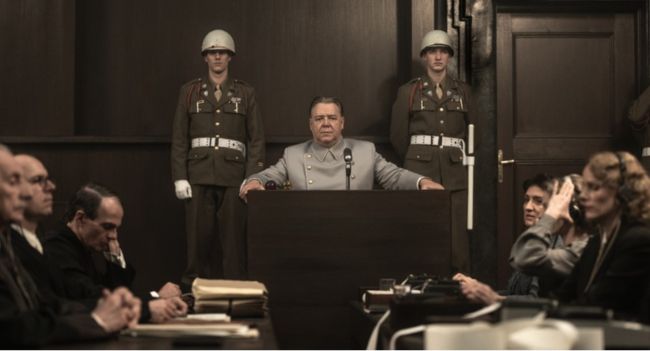
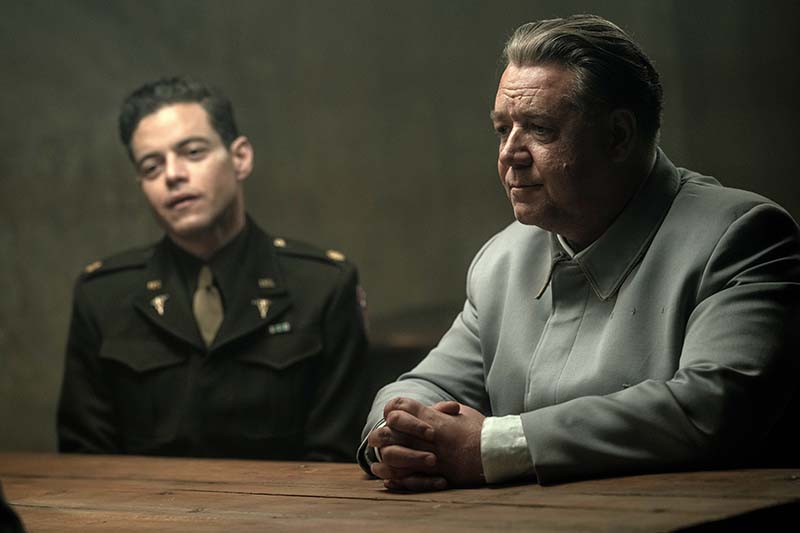
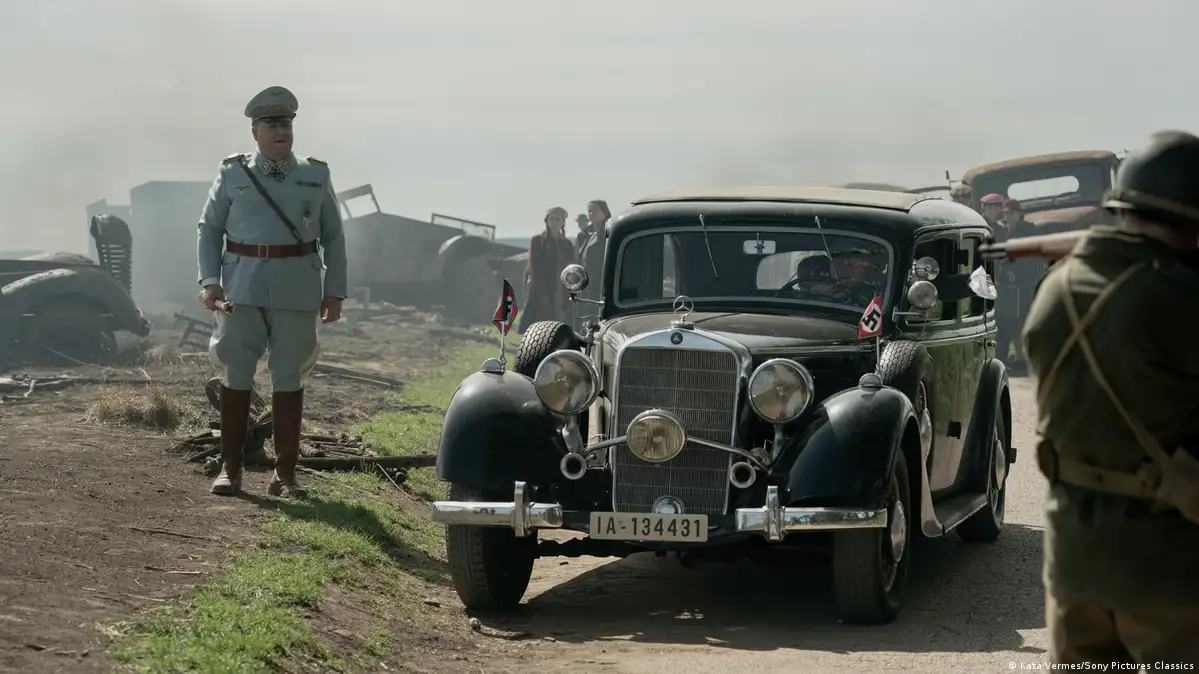
“Nuremberg” is what used to be called an Oscar movie. Or, less charitably, “Oscar bait”: The new film from director James Vanderbilt, which opens Friday, takes a subject of immense historical weight, the trial of Nazi leader Hermann Göring at Nuremberg; casts Oscar winners Russell Crowe and Rami Malek, who deliver big, showy performances; and throws money at the screen to create a slick and respectable piece of cinema.
Unlike previous films about the high-stakes trial, Vanderbilt’s film is not a courtroom drama, but rather a psychological thriller based on Jack El-Hai’s nonfiction book “The Nazi and the Psychiatrist.” “Nuremberg” focuses on the interviews between Göring (Crowe) — commander in chief of the Luftwaffe and the Reich’s second-most powerful man, behind only Hitler — and Army psychologist Lt. Col. Douglas Kelley (Malek), who must determine whether the Nazi leader is mentally fit to stand trial.
Kelley is young, ambitious and fascinated by the nature of evil.
“What if we could dissect evil?” he asks early on. “What makes the Germans different from us?”
Spoiler alert: not much.
In his own book, “22 Cells in Nuremberg,” Kelley concluded that the Nazis on trial, including Göring, were ordinary men — ambitious and cruel narcissists, perhaps, but not psychopaths — and warned that the capacity for Nazi-level evil is not uniquely German, but present in every society, including America’s.
That’s the core of Vanderbilt’s argument, the existential warning pulsing through “Nuremberg.”
The Nuremberg trials started 80 years ago
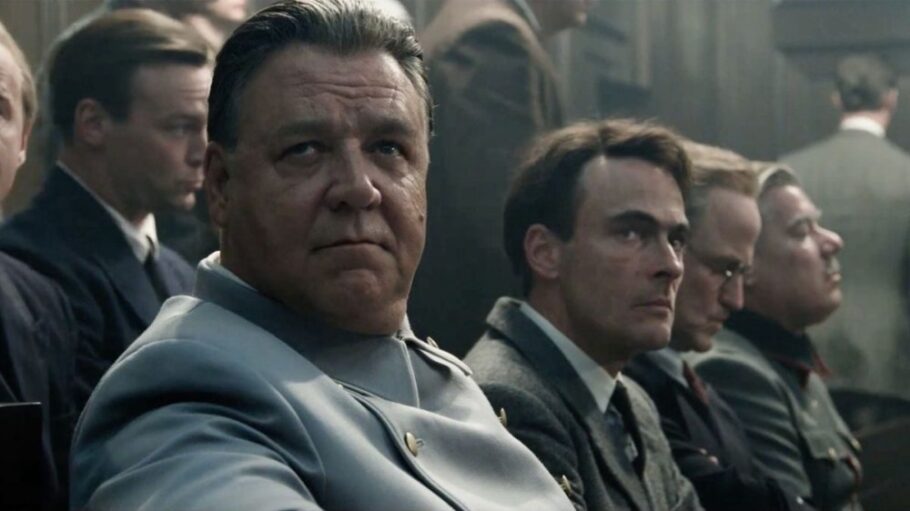
The Nuremberg trials were held from November 20, 1945, to October 1, 1946, when the Allies prosecuted 22 of the top surviving Nazi leaders, as well as six German organizations.
It’s been 80 years since the Nuremberg tribunal established the tenets of international law, along with the concept — if not always the reality — that crimes against humanity will not go unpunished.
But the memory of that moment has faded, along with the lessons supposedly learned from World War II and the Holocaust. The slogans, symbols and ideology of Nazism are back with a vengeance, embraced by the far right across Europe, the United States and beyond. The plea of “never again” feels more urgent than ever.
A film reminding viewers that we’ve been down this road before, and know where it leads, seems a worthy endeavor.
But the effect of “Nuremberg” is oddly hollow. This is a piece of glossy entertainment that’s more show than trial.
A polished production that clashes with the horrors it depicts
The subject of “Nuremberg” has lost none of its urgency, but Vanderbilt’s film feels old-fashioned in the worst way — a prestige picture that sidesteps, rather than confronts, its own conclusions.
Vanderbilt’s Göring is never an ordinary man made monstrous, but always larger than life. How could he be otherwise, played by Russell “Gladiator” Crowe?
The acting in “Nuremberg” is nevertheless superb — Crowe especially, as the portly, wily Göring, whose every joke and aside is calculated for strategic effect. The confrontations, in the interrogation room and the courtroom, are sharply staged. The production design is as polished as you’d expect from a prestige Hollywood release.

But the film’s sheen clashes with the horror it depicts. The director sets out to make a film about moral reckoning, but settles for one about performance: Göring’s for the court, the actors’ for the camera, Hollywood’s for its conscience.
At a key point, prosecutors present concentration camp footage; Vanderbilt chooses to show the real images. But instead of grounding the film in gravity, the scenes of maimed, mangled, emaciated bodies only emphasize how mannered and contrived everything around them feels.
It’s the opposite effect of Jonathan Glazer’s Oscar-winning “The Zone of Interest,” whose ordinary, undramatic staging — shot in natural light, at a distance, with no score — amplifies the banal monstrosity of Auschwitz commandant Rudolf Höss.
The implications of the Nuremberg trials
The spectacle at the center of “Nuremberg” feels all the more hollow given the state of international law. By the end, we’re meant to cheer the triumph of justice, yet the International Criminal Court in The Hague, Nuremberg’s successor, has done little to prevent modern-day atrocities, such as those unfolding in Ukraine and Gaza.
There have been several movies and documentaries about the Nuremberg trials, including Stanley Kramer’s 1961 classic, “Judgment at Nuremberg,” starring Spencer Tracy, Burt Lancaster, Marlene Dietrich and Maximilian Schell. The film was nominated for 11 Oscars and won two, and was selected in 2013 for preservation by the US Library of Congress as being “culturally, historically, or aesthetically significant.”

What made Kramer’s “Judgment at Nuremberg” endure was its willingness to implicate not only the Germans, but the audience watching.
That’s missing in “Nuremberg”: Vanderbilt gestures toward that danger — “What makes them different from us?” — but retreats into the safety of period decorum. The result is a film about evil that’s too carefully lit to get its hands dirty.
In the end, “Nuremberg” doesn’t fail for lack of craft but for lack of conviction. The questions it raises, about accountability, complicity and the fragility of international justice, could not be more pressing. Yet for all its polish and power, the film never escapes the courtroom. It recreates history without truly reckoning with it.


